MicroWorld 2.0 – Thirsty Bear Brewing Co.

Bottle Cap Brew Blog - Jackie BluesteelThinking of heading to San Francisco? Great choice. First – The weather is aggressively pleasant. Seriously. The temperature is in the low 60s every hour of the day, every day of the year (or at least during my 2-day trip earlier this month.) Second – There’s tons of stuff to do. The Golden Gate Bridge, Fisherman’s Wharf, Lombard Street and cable cars are just a few of the amazing sights to see. Want more? How about a brewpub? I headed to Thirsty Bear Brewing Co.

This place is downtown, and with AT&T Park just a short walk down the street, its location makes it a great place to stop in before (or after the ballgame.)

When you walk in, you notice things are high-end, which can be a little intimidating for low-lives like myself. I stayed anyway. For being just a stone’s throw from the home of the defending World Series champion Giants, I expected to see more Giants stuff on the walls. Instead I found one, lone orange pennant. The pennant was grossly outnumbered by the gigantic (and borderline pretentious) art pieces hung throughout the two-story pub. By the way, I’m not entirely sure what makes art pretentious. As I mentioned, I’m a low-life.

The TVs in the joint did, however, show sports. Bonus points were also earned for the pool tables available upstairs and the chalkboards positioned around the bar that gave vital stats for each of their brews – alcohol by volume, international bitterness units, etc. I was also digging the “certified organic” label the brewery proudly touts.

Points were subtracted for hiding the fermenters and other brewing equipment behind the bar. I think it adds intrigue to the place to show people how the beer they’re drinking was made. They also lost points for the terrible slow music they had playing. This placed really needed to liven up.

Here’s the rundown of the beer I found on my visit


  • Polar BearTheir description: Golden Bohemian-style pilsner. My description: A good, solid pilsner with a great taste.
  • Golden Vanilla – Them: Light, smooth ale infused with whole vanilla beans. Me: I’m impressed. The fun vanilla taste comes through in the end and doesn’t make me want to punch a teddy bear. Not sure I could handle an entire pint of this though.
  • Valencia WheatThem: Belgian-inspired white brewed with coriander and orange peel. Me: This beer continues to reaffirm my growing belief that I just don’t like wheats.
  • Brown BearThem: Classic British-style brown ale with a robust and malty body. Me: A nice malty, sweet taste. More sweet than expected.
  • Meyer ESBThem: Extra Special Bitter, smooth caramel body balanced by floral hop aroma, nitrogen conditioned. Me: Nothing special. Not great.
  • Kozlov StoutThem: Black ale brewed with black malt, chocolate malt and roasted barley, nitrogen conditioned. Me: Pretty good. Nice flavors but they could have been a little fuller and longer lasting. Maybe I just think stouts should linger longer. Maybe this was more of a porter.
  • Howard Street IPAThem: Well-bittered, strong ale with citrus notes. Me: Amazing. Great citrus taste – grapefruit. Not bitter rind but good rind taste.
  • Cherry Stave (seasonal) – Me: Sweet and sour cherry taste as advertised, but not for me.
  • Black Bear (seasonal) – Me: This is essentially a stout. Maybe it’s a little lighter than a stout.

While “MicroWorld” is written by Tony McClary, “MicroWorld 2.0” is written by Jackie Bluesteel. It chronicles his visits to microbreweries across the U.S.

Copyright 2011 The Bottle Cap Brew Blog

Posted in MicroWorld | Tagged , , , , , , , , , , , , , | 2 Comments

Diary of a Mad Home Brewer – IPA, the conclusion

Bottle Cap Brew Blog - Arthur EdgeThe next time you want to get a lot of confused stares, mention dry hopping to a group of friends. In fact, you can probably mention it to a group of strangers if you feel extra daring.

Long story short, hops are usually added during the boil stage of beer making – very early on in the beer process. Dry hopping (only used in certain beers) is where hops are added after the fermentation has already begun or already taken place – somewhere in the middle of the beer process. Adding hops this late in the game adds a lot of citrusy notes without the bitterness that comes along with adding hops early. For those of you who are more visual learners, there’s a Samuel Adams commercial available online that explains it a little more.

IPAs are supposed to have a lot of citrusy hop character, so dry hopping our home brewed IPA only makes sense.

When we last left off, our concoction was sitting in a nice, quiet place while our yeast went to town creating a wonderful beer. After one whole week of this revelry, it was time to dry hop.

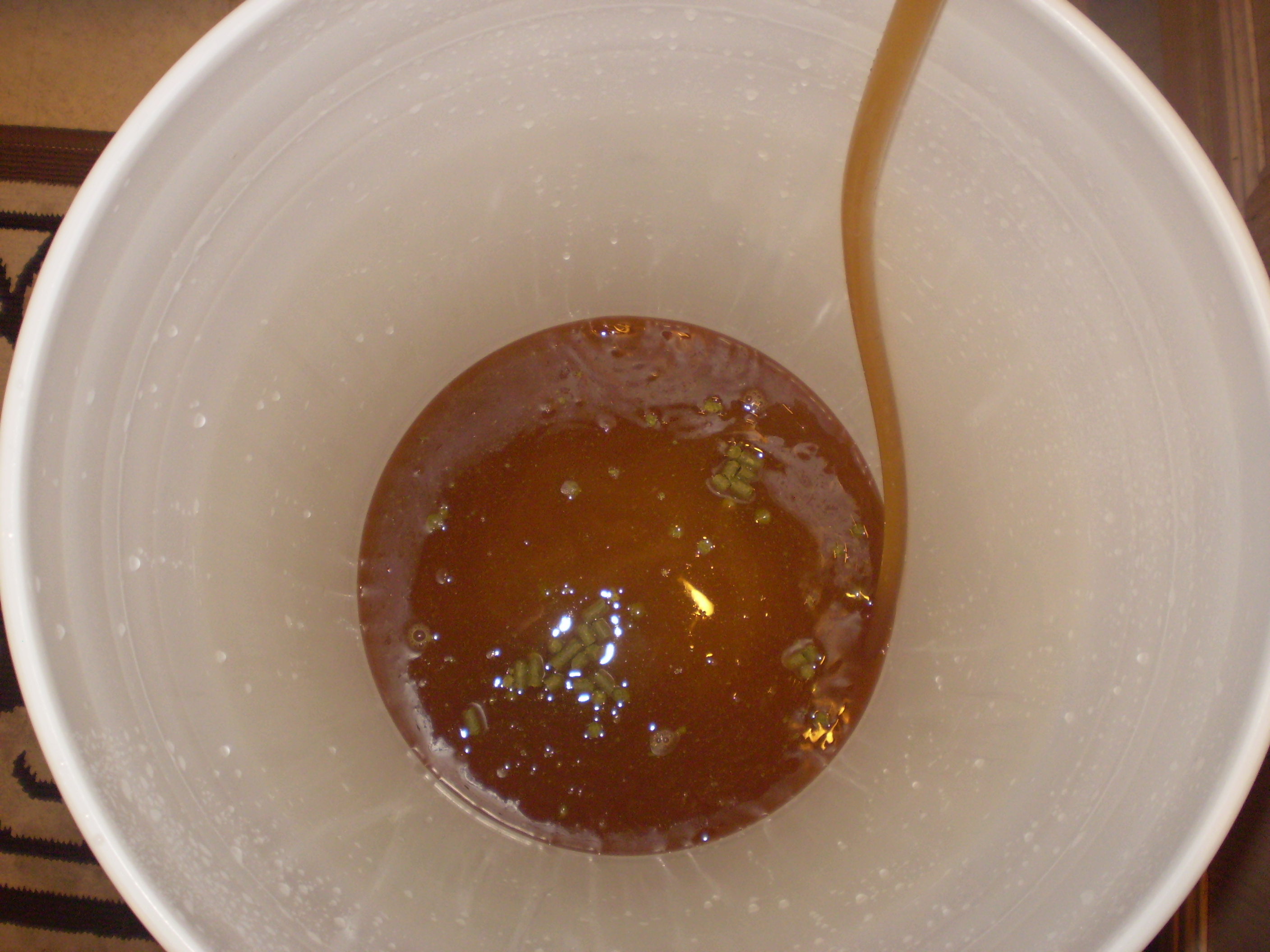
The instructions that came with our kit didn’t really provide a lot of guidance for dry hopping other than to “add remaining hops during transfer to secondary fermenter” and “allow to ferment another 7-10 days.” So that’s what we did. We dumped the rest of the pellet hops into the cleansed secondary fermenter and then racked the brew from the primary to the secondary. From there, we closed it up, allowed the new hops and the fermenting beer to get to know one another, and let the whole bubble for another week or so.

Seven days later we added priming sugar to give the beer carbonation, bottled, capped and let things condition (carbonate) for another two weeks.

Conclusion – This beer was outstanding. I loved it. The hops really stood on their own, as you want from an IPA. This was right up there with the wheat stout as our best beer to-date.

Ways to improve – I later discovered a few better ways to add the hops for dry hopping, including putting them in a muslin bag. That way the flavor can pass through while the leafy hops are confined and easily removed. While not the end of the world, getting an occasional hop bit stuck to your tongue can be an odd experience for both the person involved and those nearby. Also, we probably should have let the beer ferment for a few extra days before conditioning. I think the yeast was still a little too excited when we bottled them. While we didn’t have any exploding bottles, things got a little sudsy when we opened them up.

Next time – Hang on, folks. Next time we’ll graduate from mini mash and go full speed into brewing an all-grain red wheat beer. We’ll also trip over a bacteria issue and land flat on our faces. The good news: the bacteria won’t kill you. The bad news: the bacteria won’t make you stronger either.

Until next time. Cheers.

“Diary of a Mad Home Brewer” is written by Arthur Edge. It is a twice-monthly article looking at both the joys and inevitable failures of trying to brew your own beer.

Copyright 2011 The Bottle Cap Brew Blog
Posted in Diary of a Mad Home Brewer | Tagged , , , , , , | Leave a comment

A Taste of New Mexico — Beer Style

What words come to mind when you think of New Mexico? I bet beer isn’t one of them. Well, maybe it should be. The Land of Enchantment is home to an ever-growing number of breweries making some very good beers, and I have the proof.

My girlfriend, Chandra, and I visited seven breweries during the 4th of July weekend, putting our livers on the line to sample almost 50 ales and lagers crafted right here in New Mexico. Most of these breweries are sticking with more popular beer styles, but a few, such as Santa Fe Brewing Co. and Marble Brewery, are venturing into exciting new fermented frontiers, making wood-aged and sour or wild-fermented beers.

These are exciting times for beer-loving New Mexicans. As the popularity of craft beer grows and more breweries come online or expand, I’m sure we will see many more great offerings from New Mexico’s brewing community.

Here are our notes on the breweries and the beers in the order they were sampled, with ABV and IBU data given when available. Continue reading

Posted in Uncategorized | 2 Comments

Diary of a Mad Home Brewer – IPA, Mini Mash

Bottle Cap Brew Blog - Arthur EdgeIPAs, or India Pale Ales as people with enough time to utter five whole syllables call them, are an interesting kind of beer. Here’s my over-simplified (but mostly accurate) version of their history.

Pale ales, and an ambition to build a great empire, had been around for a long, long time in Great Britain. At some point, the British said, “Hey, wouldn’t it be cool if we loaded up a bunch of boats with troops and pale ale and sent them all over the world?” And so they did.

As it turns out, some of those troops (and pale ale) were sent to India, which is really, really far away from Great Britain. It’s so far away, that the regular pale ales (which lean more to the malty side of the beer dial than to the hoppy side) would spoil before they made it to their destination. Solution: crank up the hops, which not only add a lot more citrusy and piney notes to the beer, but also help preserve the beer for its long voyage across the world.

Later, when those troops came back to Britain, they said, “Hey. That extra hoppy stuff was pretty good. You should keep making that India Pale Ale.” And so they did.

Fast forward a few hundred years and we found ourselves in my American kitchen doing our best to emulate the art of creating an IPA. This was the fourth batch of craft beer we tackled and frankly we were feeling pretty good about ourselves following the wicked awesome batch of wheat stout we were still enjoying. Like the wheat stout, this was also a mini-mash. Unlike the stout, we used tap water for the first time instead of store-bought drinking water. Also unlike the stout, we used a grain bag for soaking the grains, which turned out to be a lot tidier than our old method of just dumping everything into the mash and straining it out once we were done.

From there we added our extract, boiled things a whole bunch and added our hops. As our history lesson suggests, this batch also contained a lot of hops – even a fun technique called “dry-hopping” we’ll talk about next time. After the boil we cooled things down (again with our ice/ice bath method), pitched the yeast, sealed up our bucket and stored the concoction in a nice quiet place where the yeast could go to work for a while.

Next time, we’ll talk about dry-hopping and review our finished product. Thanks, as always. See you next time.

“Diary of a Mad Home Brewer” is written by Arthur Edge. It is a twice-monthly article looking at both the joys and inevitable failures of trying to brew your own beer.

Copyright 2011 The Bottle Cap Brew Blog

Posted in Diary of a Mad Home Brewer | Tagged , , , , | 2 Comments

Diary of a Mad Home Brewer – Wheat Stout, Time to Rack and Roll

Bottle Cap Brew Blog - Arthur EdgeAbout a week after making our wheat stout wort, we were ready to rack the mixture from our primary fermenter to the secondary fermenter.

Racking beer is a pretty interesting idea/process. Here’s my best description, in a nutshell. Once yeast is added, wort just sits in the fermenter for a determined period of time (usually a few weeks or so) while the yeast eats the sugar in the mixture and turns it into alcohol. During this process, gravity will grab spent yeast, hop bits and other extraneous materials in the mixture and pull them to the bottom of the fermenter where they settle. Similarly, buoyancy will help other materials float to the top. This leaves a wonderful middle layer of beer free from impurities.

So, how are you supposed to go get that middle layer of beer sandwiched between impurities? That depends on your fermenter. We use plastic buckets for our primary and secondary fermenters. One of which has a spigot strategically placed an inch or so from the bottom. If you plan it right, and use the spigot-ted bucket for the first round of fermentation, you can simply attach a cleaned hose to the spigot and let the beer flow from the primary fermenter to a cleaned secondary fermenter. The spigot is high enough not to pick up any of the sediment that has accumulated at the bottom of the bucket. You can also turn the spigot off accordingly to avoid anything you might not want that’s floating on the top.

If your fermenter is spigot-less, you can use a racking cane. These kind of resemble an enormous bendy straw. Simply stick the long end of the cane into the appropriate depth of the fermenter, attach a cleaned hose to the bendy end and let the physics of siphoning take over. After the transfer, we resealed the fermenter and waited another week before bottling. Two weeks after that, we were ready to rock. When I say, “rock,” I actually mean, “drink some wheat stout.”

In a word, this stuff was amazing. The aroma of our wheat stout was something along the lines of a mocha frappuccino. The chocolate and coffee flavors really stood out. The head was thick, rich, creamy and tan in color. The flavor was awesome, again with coffee and chocolate characteristics, but nothing too heavy or lingering. This is by far my favorite beer to-date. I had no complaints about the finished product.

Tune in next time fans, when we tackle the hop-tastic goodness of an IPA. See you soon. Cheers.

“Diary of a Mad Home Brewer” is written by Arthur Edge. It is a twice-monthly article looking at both the joys and inevitable failures of trying to brew your own beer.

Copyright 2011 The Bottle Cap Brew Blog

Posted in Diary of a Mad Home Brewer | Tagged , , , | 3 Comments

Diary of a Mad Home Brewer – Wheat Stout, Mini Mash

Bottle Cap Brew Blog - Arthur EdgeYou know the safe, comfortable feeling you get when you’re around something familiar, something you’ve known for a while? Okay, another thought. You know the fun, exciting feeling you get when you try something new and spontaneous? Well, mash both of those together and that’s kind of like what we were shooting for with this latest episode in home brewing, the wheat stout.

Stouts are great. They’re tasty, dark ales. They have rich, foamy heads. Because of their Irish lineage, these things are the bomb around St. Patrick’s Day. In fact, they’re actually used in “Irish Car Bombs,” a drink for those looking to get drunk and looking to pay homage to political strife in Great Britain at the same time. Stouts are usually made with some combination of dark roasted barley, not so much with wheat. Hence that new and spontaneous feeling.

Continue reading

Posted in Diary of a Mad Home Brewer | Tagged , , , , , | 3 Comments

Drowning the Science Out – Glass Half Empty?

Bottle Cap Brew Blog - Patrick JenkinsWhen it comes down to it, most people are really bad at guessing amounts of stuff. Even before heading to the bar. I, for one, cannot determine how many jelly beans are in a jar just by looking at it. I’ve gotten really close by some fancy math algorithms* but I can never get it spot on. Based upon a website with a thinking baby on it, 77 percent of people will overestimate the amount of jelly beans in a jar.

While guessing volumes isn’t their thing, our eyes are ridiculously good at determining linear accuracy. Don’t believe me? Then waste an hour here. We can tell if things are level or askew, at 90 degrees or not, or parallel at a glance, but if you add a depth dimension things go wrong real quick. That’s why most optical illusions use lines in some fashion to affect the way we perceive depth.

Continue reading

Posted in Drowning the Science Out | 2 Comments

April 2011

Posted in Uncategorized | 1 Comment

Why I enjoy brewing beer at home, an essay

This past weekend I went out with some friends from work. The plan was to go to another coworker’s house to play beer pong. As we walked down the beer aisle of the closest convenience store I saw him stop short of the beer and pause at the wine/wine cooler section and pull out two bottles of MD 20/20 (which according to him is grape-wine flavored with citrus spirits). I asked him why the hell he would buy that when there is so much great alcohol and beer available? His response: “Itʼs awesome and has no
after taste.” (Or something along those lines.) I went for a 6-pack of Sam Adams Boston
Lager and a pint of Jack Daniels; he looked at me and cringed.

Itʼs true I have eight to nine years of drinking experience on him and perhaps one day his tastes too will evolve, but for now I pity him. He thinks that drinking should be easy and get you drunk quick. I donʼt disagree with him too much on this point, but I know that drinking can be so much more than looking forward to that buzz and it can be appreciated. That is why I am loving brewing my own beer.

Continue reading

Posted in Uncategorized | 6 Comments

Eat, Drink and Be Merry… Dammit! – Stadium Food

The weather is getting warmer, trees are getting greener, fantasy teams have been drafted and spring training is over; it is officially baseball season. There’s nothing quite like sitting in the stands with
your favorite stadium staple and an ice cold beer.

I was sitting on my couch watching what must have seemed like an endless marathon of opening day baseball to my wife when I saw something that disturbed me a little, but also got me thinking. In the very first game of the season, a laugher between the Tigers and Yankees, the camera flashed to the crowd and a middle-aged man eating sushi at the baseball game. Of course this gentleman was sitting in seats way more expensive than I could ever afford, and I’m sure he paid a pretty penny for that California roll. My question is, what happened to peanuts and cracker jacks? Where are the hot dogs with mustard and relish and a frosty beer? Where does it end?
Do they serve a nice chardonnay with that raw fish?

Continue reading

Posted in Eat Drink and Be Merry... Dammit! | Tagged , , , , , , , , , , , | Leave a comment